
The Municipal Core Paradigm
📖 Scroll to read the sample of Taming AI: The Municipal Core below.
Click and Download the Free Taming AI: Infrastructure Blue
TAMING AI: THE MUNICIPAL CORE
TABLE OF CONTENTS
THE BICYCLE AND THE CORE ……………………….. …………….viii
The Atomic Layer 1
The Stone Computer ………………………………………… ….. 6
The Digital Vacuum ……………………………….. …………… 9
The Quantum Frog ……………………………………… ………. 16
The Exocortex ……………………………………….. ……….. 19
The Municipal Core ……………………………………. ………. 22
The Unshakeable Signal ……………………………… …………. 28
The Sovereign Mesh ……………………………………. ………. 31
Section II: The Operator’s Playbook
Adversarial Prompting & The Steelman Audit ….. ……….. 38
The Human-in-the-Loop Verification Standard …… …….. 43
Epistemic Humility & Divergence Routing ……….. …… 48
Principle IV: Epistemic Custody & Data Sovereignty …. …… 54
The Socratic Bicycle Rule ………. 59
SECTION III: THE MAKE-READY SCHEDULE
Compute as the 5th Public Utility ……………………… ……….. 65
The Anti-Extraction Ordinance………………………… ………71
The Municipal Revenue Model…………………………. ………… 77
The Civic Dividend …………………………………….. ……… 82
The Conway Model……………………………………. ………… 86
The Sovereign Utility ……………………………….. ………… 88
The 36-Month Implementation Timeline ………. …………….92
The Computing Utility Evolution …………………….. ………….. 101
The Municipal Workforce ………………………………. ……….. 105
The Sovereign Mesh & Municipal Interconnects….. …………. 110
The Sovereign Choice ……………………………………. …….. 116
APPENDIX A
The Homebrew Builder’s Field Manual………………………… 120
APPENDIX B
Institutional Compliance & Material Safety Framework…… 127
APPENDIX C
Model Anti-Extraction Ordinance…… 131
PREFACE:
THE BICYCLE AND THE CORE
In 1980, Steve Jobs shared a simple observation that captures the ideal relationship between human beings and machines. He pointed to a study comparing the locomotive efficiency of various species on Earth. The condor topped the list, gliding effortlessly across vast distances, while humans finished with an unimpressive showing somewhere in the middle third.
But when the study tested a human riding a bicycle, the math shifted completely. The human on a bicycle blew the condor away.
Jobs called the computer a “bicycle for the mind”—a quiet, highly efficient mechanical tool designed to amplify human capability without destroying human agency. It was an empowering vision: technology built to human scale, serving human intent, governed by the person operating the pedals.
Somewhere over the past two decades, we lost the bicycle.
In its place, corporate monopolies constructed giant, centralized fortresses. To feed the rising computational demands of modern artificial intelligence, the tech sector built sprawling, five-hundred-acre data complexes that consume gigawatts of power, siphon millions of gallons of municipal water for cooling, and strain regional electrical grids. They turned computing from a quiet, localized tool into a predatory resource vacuum.
Worse still, they told us this was the only way—that to participate in the future, working-class communities had to surrender their land, water, and power grids to a distant, opaque corporate cloud.
They lied about the physics.
This book is the story of how we reclaim the machine. It traces two parallel journeys: the physical evolution of materials science—from nineteenth-century graphite experiments to a strip of Scotch tape in a Manchester lab—and the conceptual evolution of human intelligence, from vacuum tubes to Ray Kurzweil’s vision of an extended neocortex.
When you unite advanced materials science, specifically turbostratic graphene interlayers and room-temperature quantum nodes, the physics change completely. The acre-scale data fortress collapses down into a modular, quiet, building-integrated cabinet.
We call this the Municipal Core—or TGAI.
When computing shrinks to cabinet scale, the politics flip. Infrastructure leaves the corporate cloud and returns to local public utility ownership. Governance stops being a distant software license and becomes a physical key held by local administrators in a public building.
The future of intelligence does not belong to a corporate cloud. It belongs to your town.
Welcome to the story of how we build the Community Exocortex.
CHAPTER 1
The Atomic Layer
How the discovery of two-dimensional carbon and the mechanics of turbostratic stacking shattered the thermal limits of solid-state engineering.
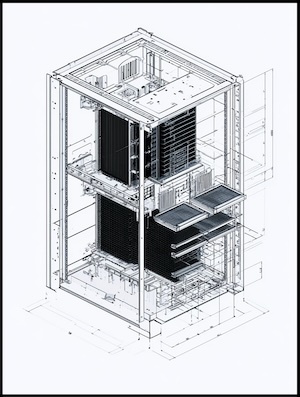
FIGURE 1.1A detailed engineering cutaway of the 1.2 m³ cabinet showing turbostratic graphene thermal plates, solid-state passive heat sinks, and zero-fluid cooling pathways with technical callout lines.
EXECUTIVE SUMMARY:
- THE ATOMIC LAYERThe Material Barrier: For decades, theoretical physics asserted that two-dimensional crystals could not physically exist without collapsing into thermodynamic soot.
- The Empirical Discovery: In 2004, the scotch-tape isolation of graphene proved the existence of single-atom hexagonal carbon sheets possessing exceptional physical properties—over 100 times the tensile strength of steel and thermal conductivity exceeding 5,000 W/m·K (over ten times that of pure copper).
- The Turbostratic Solution: While standard Bernal-stacked graphene suffers from interlayer crosstalk and thermal degradation when bundled, rotational misalignment in Turbostratic Graphene (TG) electronically decouples adjacent sheets—preserving pristine single-layer thermal extraction even in dense 3D volumes.
- The Civic Opportunity: Synthesized rapidly via Flash Joule Heating (FJH) from local municipal carbon waste and biomass, TG transforms abundant, low-cost materials into the ultimate solid-state heat highway, removing the fluid-cooling bottleneck that constrains localized high-density computing.
On a damp autumn afternoon in 1859, the English chemist Benjamin Collins Brodie stood over a vessel of concentrated nitric and sulfuric acids at the Royal Institution in London. He was attempting to map the fundamental limits of carbon by systematically breaking down natural flake graphite to see which structural remnants might survive chemical oxidation.
- What Brodie isolated under his microscope was a pale, flaky slurry of oxidized carbon sheets. Without modern spectroscopy or atomic force microscopy, he could not see the individual lattice sites. Yet his mathematical notes contained a startling intuition: he proposed that carbon was not merely a three-dimensional bulk mineral like diamond or coal, but rather a distinct two-dimensional atomic structure—a single, planar sheet of carbon atoms arranged in a continuous hexagonal mesh.
For nearly a century and a half, Brodie’s two-dimensional carbon remained a ghost in theoretical physics.
- By the mid-twentieth century, as quantum mechanics matured, the consensus among condensed-matter physicists hardened into dogma: a true two-dimensional crystal was physically impossible. The Landau-Peierls instability theorem argued that at any temperature above absolute zero, thermal fluctuations in a single-atomic-layer sheet would cause its lattice to vibrate uncontrollably. The sheet, theorists declared, would immediately curl up into fullerene soot, fold into carbon nanotubes, or simply melt into thermodynamic noise. Graphene was treated as an elegant mathematical abstraction—a useful tool on paper for calculating the properties of bulk graphite, but something that could never exist isolated in the real world.
Science, however, has a habit of being upended by simple tools used with stubborn curiosity.
In 2004, at the University of Manchester, Andre Geim and Kostya Novoselov ran a series of informal, unscripted Friday night experiments. They were studying bulk graphite, attempting to produce thin films for electronic measurement. Rather than using multi-million-dollar chemical vapor deposition chambers or complex molecular beam epitaxy, they reached for a roll of standard, off-the-shelf Scotch tape.
The process was deceptively simple: press the adhesive tape onto a flake of graphite, peel it away to split the layers, and repeat the process—folding the tape over and over, continually cleaving the graphite flakes into thinner and thinner fragments. Finally, they pressed the tape against a silicon dioxide wafer.
When they placed the wafer under a standard optical microscope, a faint, pinkish optical interference pattern caught their eye. There, resting on a bed of silicon oxide, was an ultra-thin shadow. It was a single, uninterrupted sheet of carbon atoms linked in a hexagonal honeycomb, just one atom thick.
They had isolated graphene.
The discovery sent shockwaves through physics. The thinnest material in the universe—a sheet so thin that a million layers stacked together would barely match the thickness of a human hair—was not only thermodynamically stable at room temperature, but possessed physical properties that defied conventional material limits:
- Intrinsic Thermal Conductivity: Graphene conducts heat at up to 5,000 W/m·K (watts per meter-kelvin)—more than ten times the thermal dissipation capacity of pure copper.
- Mechanical Strength: With a tensile strength of 130 gigapascals, it is over one hundred times stronger than structural steel while remaining completely flexible.
- Electronic Mobility: Electrons move through the hexagonal lattice at near-light speeds, behaving as massless Dirac fermions with zero effective rest mass and minimal electrical resistance.
MECHANISM: BERNAL VS. TURBOSTRATIC GRAPHENE DECOUPLING
- Bernal-Stacked (AB) Graphene: Adjacent atomic sheets align symmetrically in matching crystalline orientations. This inter-layer alignment causes electronic wavefunctions to overlap, inducing interlayer crosstalk, bandgap degradation, and a sharp collapse in thermal conductivity when layers are stacked into three-dimensional solid-state blocks.
- Turbostratic (TG) Graphene: Adjacent graphene sheets are rotationally misaligned—twisted at non-symmetrical angles relative to one another. This geometric twist completely decouples the electronic states between adjacent planes.
- The Solid-State Advantage: Each layer in a TG stack behaves electronically and thermally as an isolated 2D vacuum sheet, maintaining the maximum 5,000 W/m·K ballistic thermal conductivity even within dense, macroscopic volumetric arrays.
Yet, as industrial researchers rushed to commercialize the material, they immediately hit a secondary wall. Standard chemical synthesis produced Bernal-stacked (AB) graphene, where adjacent sheets align symmetrically. In this aligned state, the atomic layers interact electronically, leading to interlayer crosstalk, bandgap leakage, and a sharp drop in thermal performance when bundled into macroscopic structures.
The breakthrough required for localized, high-density computing came with the discovery of turbostratic graphene (TG).
In a turbostratic layer, adjacent carbon sheets are rotationally misaligned—twisted at random angles relative to one another. This structural twist decouples the electronic states between the layers. The sheets behave electronically and thermally as if each one were floating isolated in a vacuum, preserving the material’s extraordinary 5,000 W/m·K thermal highway even when pressed into dense, macroscopic stacks.
Furthermore, with the advent of Flash Joule Heating (FJH)—a process that passes an intense, millisecond electrical pulse through organic carbon waste—high-purity turbostratic graphene no longer requires expensive chemical refining. It could be upcycled directly from municipal organic waste, sawdust, or discarded plastics at negligible cost.
The thinnest material in existence, born from a piece of sticky tape and refined from municipal waste, had solved the single greatest physical constraint of modern computing: the extraction of extreme heat without mechanical fluids.
The atomic layer was ready. The next hurdle was the silicon wall itself.
INTERLUDE I
The Stone Computer
How humanity’s five-thousand-year lineage of building physical instruments for cosmic geometry led from megalithic stone to modern computation.
EXECUTIVE SUMMARY: THE STONE COMPUTER
- The Physical Lineage of Computation: Computing was never an abstract digital invention; it began as tangible, physical infrastructure carved directly into the earth to capture natural geometric and temporal cycles.
- From Megaliths to Mechanics: The progression moves unbroken from megalithic registers like Stonehenge and calibrated sundials to mechanical cathedral clocks, translating continuous physical motion into discrete calculation.
- The Conceptual Leap: Charles Babbage recognized that gear teeth could track mathematical variables, but Ada Lovelace realized numbers could represent arbitrary symbols, patterns, and logic—authoring the first algorithm and framing computation as a medium for general thought.
- The Continuing Thread: Modern hardware architectures, from mechanical brass gears to solid-state carbon lattices, are physical instruments designed to harness the structural laws of physics to process information.
Long before Charles Babbage dreamed of brass gears calculating logarithms, human beings were carving computers out of the earth itself.
Stand at the center of Stonehenge during a summer solstice, and you are standing inside an information processing system. The megaliths were not decorative monuments; they were physical registers designed to capture, calculate, and display the precise orbital mechanics of the Earth and Sun. The alignment of those massive sarsen stones stored data across generations, executing a simple, reliable visual algorithm every June: if the sun rises over the Heel Stone, the axis of the year has turned.
The sundial brought that macro-scale stone computer down to human height. By placing a gnomon in the earth, our ancestors used the shadow cast by planetary rotation to render invisible temporal motion visible on a flat, calibrated surface. Information was not abstract; it was a physical shadow moving across stone.
By the fourteenth century, European blacksmiths and clockmakers translated that moving shadow into spring-loaded iron escapements. Towering cathedral clocks did not just measure time; they converted continuous natural motion into discrete, mechanical ticks.
When Charles Babbage looked at a clockwork mechanism in the 1830s, he did not just see a timepiece. He realized that if gear teeth could track the hours of the day, they could also track abstract mathematical variables. Babbage’s proposed Analytical Engine was simply a cathedral clock stripped of its clock-face, repurposed to count numbers instead of minutes.
Yet, Babbage saw his machine primarily as an iron calculator—a faster way to compute tax tables and navigation charts. It took the visionary mathematician Ada Lovelace to see the machine’s true soul.
In 1843, while translating a paper on the Analytical Engine, Lovelace added a series of extensive notes that doubled the length of the original text. In “Note G,” she published the world’s first complex computer algorithm—a step-by-step instruction set for the machine to calculate Bernoulli numbers.
More importantly, Lovelace made a staggering conceptual leap that bypassed a century of technology. She realized that if the machine’s gears could represent numbers, those numbers could in turn represent letters, musical notes, or logical symbols. “The Analytical Engine,” she wrote, “weaves algebraical patterns just as the Jacquard loom weaves flowers and leaves.” She intuited that computation was not merely arithmetic; it was a medium for processing abstract thought.
Babbage built the engine’s skeleton out of brass, but Lovelace gave it a mind.
The quest to build a computer was never an invention from thin air. It was simply the next step in a five-thousand-year human obsession: building physical traps for the hidden geometry of the universe.
CHAPTER 2
The Digital Vacuum
How the collapse of Moore’s Law and the physical limits of sub-3nm silicon forced modern computing into an unsustainable corporate crisis.
EXECUTIVE SUMMARY: THE DIGITAL VACUUM
- The Physical Evolution: Computation evolved from mechanical gears (Babbage) and theoretical logic (Turing) to fragile vacuum tubes (ENIAC), before solid-state silicon transistors enabled decades of exponential scaling under Moore’s Law.
- The Physical Evolution: Computation evolved from mechanical gears (Babbage) and theoretical logic (Turing) to fragile vacuum tubes (ENIAC), before solid-state silicon transistors enabled decades of exponential scaling under Moore’s Law.
- The Silicon Wall: Below the 3-nanometer threshold, silicon architectures suffer from quantum tunneling leakage and parasitic electrical resistance—converting vast amounts of incoming electricity directly into destructive waste heat.
- The Corporate Scaling Trap: Hyperscale data centers attempt to bypass fundamental physics by building acre-scale fortresses that drain 100–500 MW of municipal power and evaporate millions of gallons of water daily just to vent heat into the atmosphere.
- The Sovereign Inversion: By replacing resistive copper/silicon traces with photonic laser logic and solid-state Turbostratic Graphene (TG) highways, internal waste heat generation is slashed by over 92%, while the remaining thermal exhaust is captured to drive grid co-generation.
To understand why our modern digital world is grinding against physical limits, we have to look back at how we started processing information. Before there was silicon, there was vacuum—and before there was vacuum, there were mechanical gears.
In the 1830s, the English polymath Charles Babbage envisioned the Analytical Engine, a massive brass-and-iron calculator powered by steam. Babbage’s design was purely mechanical: numbers were represented by the physical rotation of gear teeth, and logic was executed as levers tripped one another in sequence. It was slow, heavy, and loud, but it established the fundamental architecture of computation: input, memory, processing, and output.
A century later, the demands of mid-twentieth-century ballistics and wartime codebreaking forced engineers to replace mechanical gears with electrical switches. Standing at the center of this transition was the brilliant mathematician Alan Turing.
In 1936, Turing conceptualized the “Universal Turing Machine”—a theoretical device that proved a single machine, given the right set of instructions on a strip of tape, could simulate any conceivable algorithm. During World War II at Bletchley Park, Turing translated that abstract mathematics into physical reality, designing electromechanical devices to break the Enigma code and laying the foundational architecture for modern computer science.
Turing didn’t just ask how machines could calculate; he asked what computation truly meant. In 1950, he published his seminal paper proposing the Turing Test, famously opening with the question: “Can machines think?” Turing recognized that computation was not merely about crunching numbers, but about processing logic at scales that could eventually mimic human cognition.
To realize Turing’s vision, however, hardware had to shed its slow mechanical levers. The first electronic digital computers used vacuum tubes—glass bulbs containing metal filaments that controlled the flow of electrons through a vacuum.
Vacuum tubes were a triumph, but they were fragile, hot, and inefficient. A single machine like the ENIAC, built in 1945, contained nearly 18,000 vacuum tubes, consumed 150 kilowatts of power, and generated so much ambient heat that the room required industrial ventilation fans just to keep the glass bulbs from melting.
The breakthrough came in 1947 at Bell Labs, when John Bardeen, Walter Brattain, and William Shockley invented the point-contact transistor. By replacing bulky, glowing vacuum tubes with microscopic solid-state switches made of semiconductor materials like germanium and silicon, computing took its first leap into human scale.
For half a century, silicon delivered on an astonishing promise. In 1965, Gordon Moore, co-founder of Intel, observed that the number of transistors packed onto a single silicon chip was doubling roughly every two years. Moore’s Law became the rhythm of the modern world. Chips grew smaller, faster, and cheaper with predictable regularity.
Then, silicon hit the wall.
By the early 2020s, semiconductor manufacturers were carving transistor channels down to 3 nanometers—a scale so impossibly small that a single transistor gate was only a dozen atoms wide. At this atomic threshold, standard silicon physics breaks down.
When silicon processing nodes operate below 3 nanometers, they encounter a phenomenon known as quantum tunneling. Electrons no longer stay neatly behind the physical gate boundaries of the transistor; instead, they “leak” across the barrier, flowing continuously even when the switch is turned off. Combined with standard electrical resistance in copper and metal interconnects, this thermodynamic leakage generates intense localized heat. Instead of performing useful calculations, a significant portion of the electricity entering a modern high-density silicon chip is converted directly into wasted thermal energy.
As artificial intelligence models exploded in scale, requiring trillions of matrix math calculations per second, the tech industry faced a crisis: how do you keep scaling computing power when silicon chips are literally melting themselves?
Their answer was not to fix the material physics, but to build larger buildings.
Corporate tech monopolies began constructing sprawling, acre-scale data complexes—horizontal fortresses housing hundreds of thousands of silicon processors running simultaneously. Because these dense arrays of resistive silicon generate millions of thermal units per minute, the facilities require building-scale liquid plumbing systems, giant industrial fans, and cooling towers that blast chilled water continuously over the hardware racks.
These complexes operate as resource vacuums. A single 500-acre hyperscale data center can draw between 100 and 500 megawatts of continuous grid power—enough electricity to power a city of 100,000 homes. To cool the hardware, these facilities evaporate millions of gallons of municipal water every day, straining local water tables and leaving surrounding communities with higher utility rates, noise pollution, and vulnerable power grids. In the corporate cloud model, thermal output is treated as a destructive waste product—vampirizing community resources simply to vent excess heat into the atmosphere.
The tech industry claimed this was the unavoidable price of progress—that to have modern artificial intelligence, society had to accept giant corporate data fortresses consuming local resources.
It was a false choice. The massive physical footprint and environmental destruction of the modern data center are not requirements of intelligence; they are artifacts of outdated silicon design.
By transitioning from resistive silicon to ballistic Turbostratic Graphene (TG) pathways and photonic laser logic, we eliminate electrical resistance at the atomic level. Furthermore, instead of treating residual heat as pollution to be flushed away with local water, TG solid-state thermal highways siphon that clean thermal energy directly to the cabinet boundary. There, it drives compact micro-turbines and thermoelectric generators—converting thermal exhaust back into secondary electricity to feed power directly onto the local municipal grid.
To reclaim the machine, we had to move past the silicon wall, eliminate electrical resistance, and convert thermal exhaust from a corporate pollutant into a public civic utility.
MECHANISM: THE THERMODYNAMIC MULTIPLIER (BY THE NUMBERS)
- 92% Reduction in Gate Friction: Replacing conventional resistive silicon traces with photonic laser logic and turbostratic graphene pathways slashes internal waste heat generation by over 92% at the atomic gate level
- Elimination of Parasitic Waste: Where a conventional 3-nanometer silicon array wastes nearly half of its incoming electrical energy as destructive, gate-melting friction, the Sovereign Core’s optical-graphene architecture operates at near-zero electrical resistance.
- Direct Grid Feedback: The remaining 8% of thermal energy is clean, predictable optical dissipation conducted through solid-state TG highways directly to cabinet-mounted thermoelectric generators
- (TEGs) and Organic Rankine Cycle micro-turbines—delivering 100% compute output while generating secondary current for the local power grid.
We do not merely cool the machine; we eliminate its friction and harness its light.
INTERLUDE II
The Quantum Frog
How living biology mastered room-temperature quantum tunneling millions of years before silicon computing hit its physical wall.
EXECUTIVE SUMMARY: THE QUANTUM FROG
- The Engineering Paradox: Silicon chip designers treat quantum tunneling as a destructive failure mode that leaks heat and breaks gate insulation at the sub-3-nanometer scale.
- The Biological Reality: In nature, quantum tunneling is an essential catalyst operating at room temperature—powering everything from rapid tadpole metamorphosis and photosynthesis to avian magnetoreception.
- The Hardware Lesson: Biology does not fight quantum mechanics with cryogenic refrigeration or massive cooling towers; it harnesses room-temperature particle shortcuts inside organic carbon matrices.The
- Architectural Shift: True computational scaling comes from abandoning rigid, overheating silicon bricks in favor of carbon-based architectures like Turbostratic Graph
When modern computer engineers talk about quantum tunneling, they usually speak of it as an industrial disaster—the moment an electron illegally hops across a sub-3-nanometer silicon barrier, leaking heat and threatening to melt a multi-million-dollar processor chip. We treat quantum mechanics as an unnatural, fragile beast that can only survive inside a sterile cleanroom or a cryogenic deep-freeze.
Nature, as usual, knows better.
For decades, developmental biologists struggled to explain the sheer speed of biological metamorphosis. Consider a tadpole swimming in a farm pond. Over the course of a few short weeks, it completely dissolves its own aquatic organs, reconfigures its digestive system, sprouts lungs, and builds legs to walk on land as a frog.
If this transformation relied purely on classical chemical kinetics—molecules floating around randomly waiting to collide with the right enzyme at standard temperatures—the process would take months, if not years. The tadpole would die long before it ever jumped.
Enter quantum biology.
Researchers discovered that enzymes inside the transforming amphibian utilize quantum tunneling to accelerate biochemical reactions by factors of millions. Instead of waiting for a hydrogen atom to overcome a massive chemical energy barrier, the biological system allows the particle to exploit its wave-like nature, “tunneling” straight through the energy wall instantly.
Nature does not fear quantum tunneling; it relies on it. It uses quantum shortcutting at room temperature in muddy pond water to turn an aquatic larva into an air-breathing frog, to drive photosynthesis in green leaves, and to help migratory birds sense the Earth’s magnetic field.
Silicon engineers didn’t discover a new physical hazard when they scaled down microchips. They simply bumped into the exact same quantum mechanics that biology learned to master eons ago.
The mistake wasn’t using quantum physics. The mistake was trying to force those quantum principles through rigid, overheating silicon bricks, rather than aligning our hardware with the fluid, carbon-based physics of the natural world.
CHAPTER 3
The Exocortex
How the noble vision of human-machine symbiosis was centralized into a corporate toll road, and why computation must return to human scale.
EXECUTIVE SUMMARY: THE EXOCORTEX
- The Bicycle for the Mind: From Steve Jobs’ locomotive efficiency metaphor to Ray Kurzweil’s synthetic neocortex, computing was originally conceived as a tool to amplify human agency, not replace it.
- The Cognitive Bottleneck: Human biological neocortex capacity is physically bounded by skull volume; an exocortex provides a non-biological, auxiliary layer of pattern-recognition processing to solve multidimensional civic, medical, and industrial problems.
- The Extraction Hijack: Corporate tech monopolies centralized this cognitive expansion into distant, opaque data fortresses—turning an empowering bicycle for the mind into an extractive toll road that harvests local data and rents back intelligence at monopoly rates.
- The Sovereign Reclamation: Restoring the exocortex to human scale requires breaking the cloud monopoly model and housing localized, passive-solid-state compute directly inside public municipal infrastructure governed by local citizens.
In 1980, Steve Jobs sat down in front of a camera to articulate what he believed was the true purpose of personal computing. He referenced a study conducted by Scientific American that measured the locomotive efficiency of various species on Earth—how much energy a creature expended to move a kilometer. The condor came in first place, gliding effortlessly through the sky. Man finished somewhere in the middle, an uninspired showing for a species that fancied itself the crown of creation.
Then, the researchers tested a human riding a bicycle.
With that simple mechanical linkage, the human blew the condor completely out of the water. The bicycle did not replace the human; it did not strip away human effort or locomotive agency. It simply amplified human biomechanics, turning an ordinary person into the most efficient traveler on Earth.
“That’s what a computer is to me,” Jobs said. “It’s the bicycle for the mind.”
Two decades later, the inventor and futurist Ray Kurzweil took Jobs’ mechanical metaphor and projected it into the twenty-first century. Kurzweil observed that human biological intelligence was bounded by a strict physical limit: the volume of our skulls. The human neocortex—the outermost layer of the brain responsible for higher-order reasoning, language, and abstract thought—contains roughly 300 million pattern-recognition modules. It cannot physically expand without creating catastrophic evolutionary friction during childbirth.
Kurzweil hypothesized that humanity would inevitably build a non-biological extension to its brain—a synthetic, auxiliary layer of cloud-connected processors that would act as an exocortex (a term derived from the Greek exo, meaning “outer,” and the Latin cortex, meaning “bark” or “shell”).
In Kurzweil’s vision, the exocortex would function as a seamless cognitive amplifier. Just as the bicycle allowed our legs to outpace the condor, a localized exocortex would allow a doctor, an engineer, or a farmer to process vast arrays of environmental data, diagnose complex diseases, and reason through multidimensional problems in real time. It was the ultimate expression of human-machine symbiosis—a non-zero-sum partnership where machine speed amplified human intention.
It was a beautiful concept. But as artificial intelligence matured, corporate monopolies hijacked the architecture.
Instead of building a bicycle for the mind, tech cartels built a toll road for thought. Rather than delivering a localized exocortex that belonged to the individual or the community, they centralized computational power inside distant, opaque fortresses.
The corporate cloud transformed computing from an empowering personal tool into a system of extraction. User data was harvested to train massive black-box models; local municipal power grids were strained to run high-leakage silicon chips; and civic intelligence was subjected to algorithmic lock-in. The exocortex was not given to the citizen—it was rented back to them at monopoly prices, wrapped in legal agreements that stripped away privacy and physical custody.
Worse, this centralization birthed profound psychological alienation. When people interact with a disembodied AI residing inside a boundless, invisible corporate cloud, they naturally feel disempowered. The machine feels less like a bicycle under their feet and more like an unpredictable, external authority hovering over their lives.
To fulfill the true promise of the exocortex—to build a cognitive tool that honors human dignity and civic sovereignty—we have to tear down the corporate cloud model.
We do not need a distant silicon leviathan. We need a localized, community-owned brain that sits inside a public building, powered by clean local energy, cooled by passive materials physics, and governed by the citizens it serves.
We need to bring the exocortex back down to human scale.
CHAPTER 4
The Municipal Core
How compressing computation into modular solid-state cabinets inverts digital colonialism and restores technological sovereignty to local towns.
EXECUTIVE SUMMARY: THE MUNICIPAL CORE
- The Volumetric Collapse: Solid-state Turbostratic Graphene (TG) interlayers, room-temperature diamond NV spin qubits, and hardware-level erasure compress an acre-scale data center into a quiet, 1.2-cubic-meter standard cabinet.
- The Anti-Extraction Revenue Engine: Municipalities eliminate tax abatements and monetize computing efficiency locally by issuing “Grid Stabilization Credits” and leasing zero-fluid compute slots to private enterprise.
- Adaptive Reuse of Corporate Hulls: Stranded 500-acre corporate data centers are reclaimed by cities, converting existing gigawatt grid interties into public micro-power hubs and grid-stabilization battery/thermal centers.
- Physical Custody as the Sovereign Kill-Switch: Democratic authority is secured through an air-gapped Dual-Key Mechanical Circuit Breaker on the cabinet, providing an instant manual power disconnect that completely bypasses corporate software controls.
When computing is compressed from an acre-scale data fortress down to a modular cabinet, the politics of technology flip upside down.
For a decade, working-class communities faced an asymmetrical war against corporate tech monopolies. When a hyperscale data center target letter arrived at a city council desk, it was accompanied by corporate lobbyists promising economic growth. In reality, these facilities functioned as resource vampires—siphoning gigawatts from local electrical grids, consuming millions of gallons of municipal water for mechanical HVAC cooling, taking up hundreds of acres of prime land, and driving up utility rates for residents while generating zero long-term public wealth.
By uniting the physical breakthroughs explored in this book—turbostratic graphene interlayers acting as solid-state heat highways, room-temperature diamond NV spin qubits, and hardware-flagged erasure architectures—we eliminate the need for sprawling buildings, liquid plumbing, and industrial fans.
An entire acre-scale processing node collapses into a quiet, 1.2-cubic-meter EIA 19-inch cabinet.
When computing fits inside a standard public room, it stops being a distant corporate leviathan and becomes a Municipal Core—a public utility owned, operated, and maintained by the local community.
MECHANISM: INFRASTRUCTURE MODEL COMPARISON
Traditional Data Fortress (Corporate Cloud Monopoly)
- Physical Footprint: 500-Acre Megacampus
- Resource Impact: Heavy Grid & Water Resource Extraction
- Control Model: Remote Corporate Software Control
- Economic Yield: Local Wealth & Energy Exported
- The Municipal Core (Local Public Utility)
- Physical Footprint: 1.2 m³ Modular Cabinet
- Resource Impact: Passive Solid-State Thermal Dissipation
- Control Model: Air-Gapped Physical Dual-Key Switch
- Economic Yield: Public Thermal & Grid Revenue Engine
The Anti-Extraction Revenue Engine
Under the Municipal Core paradigm, local governments do not hand out property tax abatements or free water rights to attract high-performance computing. Instead, the town owns the physical infrastructure and monetizes its efficiency through two public revenue streams:
- Grid Relief Licensing: By deploying zero-fluid, solid-state cabinets connected to local low-voltage power or municipal solar arrays, the town completely offsets its public data footprint from the regional grid. The municipality packages this verified energy relief into “Grid Stabilization Credits” sold directly back to regional balancing authorities.
- Thermal Asset Leasing: Private enterprise urgently requires high-density computing capacity but is choked by active cooling costs. Municipalities lease access to their ultra-efficient, graphene-cooled cabinet slots. Private firms pay recurring utility leasing fees directly into the municipal treasury, expanding the local tax base without adding noise or water draw to the community.
Reclaiming the Corporate Silicon Hulls
As volumetric compression shifts computing power into modular, refrigerator-sized municipal cabinets, the sprawling 500-acre commercial data fortresses built during the silicon era will face rapid economic obsolescence.
Municipalities can reclaim these empty corporate hulls through targeted infrastructure acquisitions and adaptive reuse. Because hyperscale buildings are already pre-engineered with gigawatt-scale electrical interconnects, high-capacity substations, heavy concrete foundations, and industrial power routing, they possess the ideal physical framework to be converted into municipal micro-power hubs and civic manufacturing centers.
By relocating compute workloads into compact, zero-fluid Turbostratic Graphene (TG) municipal nodes, the vast central structures are cleared of power-hungry, melting silicon arrays. Instead of drawing massive energy from local ratepayers, these reclaimed facilities become local power-stabilization hubs—housing Organic Rankine Cycle (ORC) micro-turbines and battery storage arrays that feed secondary co-generated electricity back into the municipal grid. What was once a private, resource-draining vacuum is subverted into a community-owned asset for energy resilience and economic sovereignty.
Physical Custody & The Dual-Key Switch
The ultimate resolution to public anxiety regarding artificial intelligence is not found in complex software legal agreements or corporate policy promises; it is anchored in Physical Custody.
When an AI system operates within a disembodied corporate cloud behind private security gates, citizens feel completely powerless. But when the hardware resides physically inside a local public building, true democratic sovereignty is restored.
MECHANISM: THE LOCAL DUAL-KEY MECHANICAL BREAK
Step 1: Public Facility Custody — The physical hardware is housed in a local municipal building under direct public authority.
Step 2: Municipal Cabinet Core — Computing, thermal highways, and data storage operate within a self-contained 1.2 m³ unit.
Step 3: Dual-Key Mechanical Switch — Designated local officials hold physical access keys to an air-gapped circuit breaker.
Step 4: Physical Power Disconnect — Throwing the switch physically opens the electrical circuit, severing all and external connectivity instantly—bypassing corporate cloud controls completely.
Each Municipal Core cabinet features an air-gapped, hardware-level Dual-Key Mechanical Circuit Breaker mounted directly on the front panel.
If an algorithm acts erratically, breaches local data privacy policies, or violates its civic charter, local administrators do not submit an online support ticket to a Silicon Valley helpdesk. Designated public officials insert physical access keys, manually turn the mechanism, and throw a heavy mechanical switch. The electrical circuit is physically opened, severing all power and external connectivity instantly.
The Sovereign Path Forward
The choice before local communities in the twenty-first century is stark:
- Accept the Silicon Vacuum — surrendering land, water, and power to an opaque corporate cloud that exports wealth and rents intelligence back at monopoly prices.
- Build the Community Exocortex — deploying solid-state quantum-graphene utilities that protect local resources, generate public revenue, and keep the physical key to human intelligence firmly in the hands of the public.
The materials exist. The physics is proven. The key belongs to your town.