
Chapter 1
The Breaking of Limbs is Revealed to be a Financial Strategy

The history of theatrical superstition is largely the history of people trying desperately not to starve.
Take, for instance, the phrase “Break a leg.” To the uninitiated, this sounds like the sort of enthusiastic threat one might hear in a mob-run gambling den just before the crowbars come out. However, Elizabeth Sullivan, currently occupying a wing-backed armchair that seemed to be slowly digesting her, was keen to set the record straight.
Elizabeth was in her mid-eighties. This is an age where one becomes increasingly transparent, yet somehow heavier. She sat in a pool of lamplight that cast dramatic shadows across her face, suggesting she was about to reveal the location of a buried treasure, or perhaps just complain about the draft.
“It’s simple economics,” Elizabeth said, her voice dry as a saltine cracker. “If you didn’t pass the ‘leg’—the curtain line hiding the backstage chaos—you weren’t seen by the audience. If you weren’t seen, you didn’t get paid. And if you didn’t get paid, digestion became a fond memory rather than a daily activity.”
“So,” the invisible interviewer prodded, “the leg is the curtain?”
“Precisely,” Elizabeth nodded. “Vaudeville owners possessed the optimism of a goldfish and the business ethics of a shark. They always booked too many acts. If the juggler dropped a pin or the animal act decided to eat the front row, the hook came out. Audiences were vocal. Ballistic, even. But everyone loved the dancing girls. Nothing wrong with a little leg.”
It was a simpler time. A time when entertainment was live, dangerous, and occasionally involved dodging vegetables.
In the autumn of 1926, the concept of “uptown” was less a geographical location and more a state of spiritual cleanliness. The Tamarind theater was uptown. It was a place where girls kept their clothes on, a fact that disappointed as many patrons as it relieved.
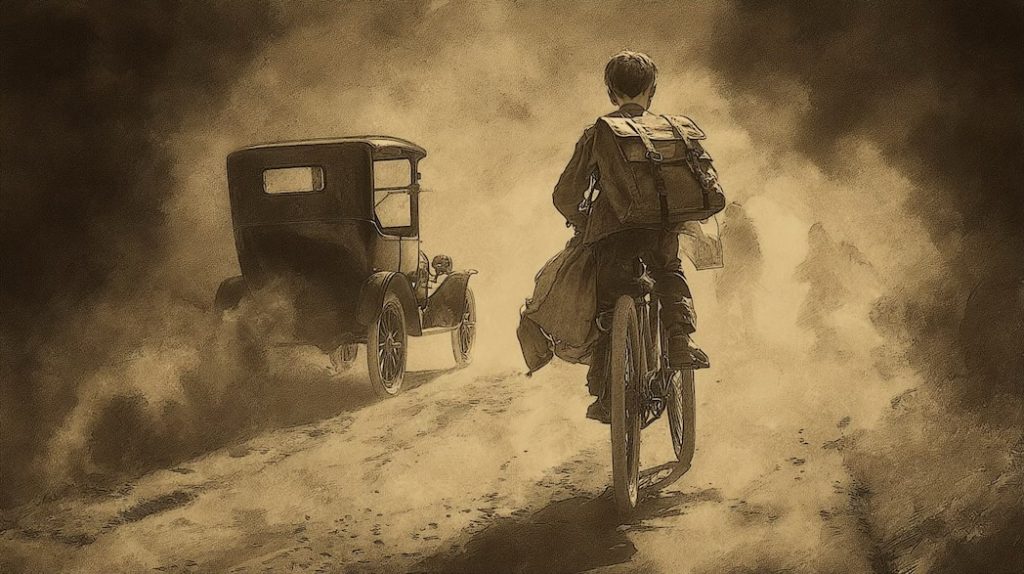
Ricky “Skids” Sullivan was currently navigating the gravel streets on a bicycle that was eighty percent rust and twenty percent wishful thinking. Skids was fifteen years old. This is a difficult biological phase for a human male; he was essentially a collection of sharp elbows and unmanaged hormones wearing a newsboy cap. He carried a canvas bag capable of holding two newspapers or a small rhinoceros, and wore knickers that had seen better decades.
A Model-T Ford roared past him. It was a machine designed to convert fossil fuels into noise and lung diseases with remarkable efficiency. It dusted Skids in a cloud of particulate matter that tasted faintly of progress. Skids stopped, waited for the atmosphere to become breathable again, and pedaled toward The Tamarind.
The Tamarind, Elizabeth’s voice echoed from the future, floating over the scene like a sentimental ghost. The Dumont had the pipe organ that shook your fillings loose. The Rialto had the prestige. But The Tamarind was home. That Tamarind is gone now. Gravity and the Great Depression eventually won the argument, as they usually do.
Skids walked through the lobby. He paused, as he always did, to admire the black and white photograph of Dixie Fountaine.
Dixie was twenty. To a fifteen-year-old boy, the gap between fifteen and twenty is not five years; it is an astronomical unit. She was an adult woman; he was a boy who still occasionally tripped over his own feet. In the photo, she looked like she knew a secret that would get you arrested. He smiled at her, a smile of pure, unadulterated adolescent crush, and then crossed to the bar.
Frankie O’Hara was there, engaging in the ancient bartender ritual of wiping a clean surface with a dirty rag until they reached a sort of grime equilibrium.
“Mornin’, kid,” Frankie grunted.
“Mornin’ Frankie,” Skids replied, dropping off a stack of papers that announced the world was still terrible.
Inside the theater proper, the air was cool and smelled of stale popcorn and broken dreams. On stage, Dixie Fountaine herself was rehearsing. She was singing “The Prisoner Song,” a ballad of such mournful viscosity that it threatened to gum up the works of the universe. In the orchestra pit, Leonard Hochstetter played the piano with the enthusiasm of a man filling out a tax return.
“I’ll be carried to the new jail tomorrow,” Dixie crooned, “Leaving my poor darling all alone…”
Quinn Sterling marched onto the stage carrying a clipboard, the universal symbol of someone who is about to ruin everyone’s fun.
“Leonard, can you give us a minute?” Quinn asked.
Leonard stopped playing immediately. He was paid to play, but he was happy to stop for free.
“Boss is due back soon,” Quinn said, lowering his voice to a conspiratorial rumble. “You may want to change that tune.”
Dixie blinked, pulling herself out of the tragic narrative. “Oh yeah? He doesn’t like it?”
“It reminds him of his brother,” Quinn explained, “who recently had a rather shocking appointment with the electric chair.”
“Yikes,” Dixie said. The reality of state-sponsored execution tended to put a damper on artistic expression. “Lenny, pull out St. Louis Blues. Less voltage.”
Leonard segued into the blues without missing a beat.
Skids walked up to the edge of the stage and slapped a newspaper down. Quinn picked it up. The headline shouted: HYMIE WEISS KILLED.
“Who’s Hymie Weiss?” Quinn asked, staring at the bold type.
“Some gangster. In Chicago,” Skids said, with the weary tone of a man explaining quantum physics to a Labrador. “Whatsa matter? You don’t read none? It’s in all the papers.”
“I read fine,” Quinn snapped. “Jeez. Chicago must be like the Wild West with taller buildings. Say, has Carlo paid you for the paper this month?”
“Are you kidding?” Skids laughed, a dry, humorless sound for a fifteen-year-old. “He ain’t paid in three months. I think he believes news is a naturally occurring resource, like sunlight.”
Quinn sighed. It was the heavy sigh of a man who spent his life fixing things that shouldn’t be broken. “Okay, come on up to the office. I’ll get you your dough.”
They turned to walk up the aisle, the majestic gloom of the theater swallowing them.
“When’s the last time you ate?” Quinn asked, glancing down at the boy.
“I had some coffee and a day-old this morning when they brought the papers,” Skids said. “It was mostly crust, but it had character.”
“Okay,” Quinn decided. “Let’s get a sandwich from the diner. Actual food.”
As they exited, Dixie’s voice rose up behind them, singing the blues with the desperate energy of someone trying very hard not to think about electric chairs.
“I hate to see the evenin’ sun go down… It makes me think I’m on my last go ’round…”
It was a sentiment Skids understood perfectly.
Chapter 2
Regarding Baloney and the High Cost of Nicknames
Quinn and Skids stepped out of the velvet gloom of the auditorium just as the front doors swung open, admitting a slice of the outside world and a great deal of noise.
The noise was mostly Don Clarinetti.
Don was a man who seemed to be constructed entirely out of elbows and volume. He trailed behind Carlo Rizzo, flanked by a thug whose neck seemed to have lost a long and bitter argument with his shoulders. Don was gesturing with hands that looked like they had been designed for strangling poultry.
“So I says to him,” Don bellowed, addressing an audience that didn’t exist, “I says, ‘this baloney sandwich ain’t got nothin’ on you, pal!'”
Carlo Rizzo paused. He was a man of gravitational solidity, an anchoring mass in a room full of helium balloons. He offered a chuckle that sounded like a dry twig snapping under the weight of a heavy boot.
“Heh… funny.”
“Everybody just fell out, I tell you,” Don continued, entirely oblivious to the sudden drop in atmospheric pressure. “Bull, ya’ shoulda seen it, they…”
The air left the lobby. It didn’t drift away; it fled in terror.
“Don’t call me Bull,” Carlo said. He spoke softly, but in the way a geiger counter clicks softly just before you die of radiation poisoning.
Don blinked, his grin faltering like a candle in a draft. “I’m sorry, what’s that?”
The thug stepped forward. He didn’t look like a conversationalist, but he delivered his line with the precision of a stage actor who knows the play is a tragedy. “Mister Rizzo don’t like to be called Bull.”
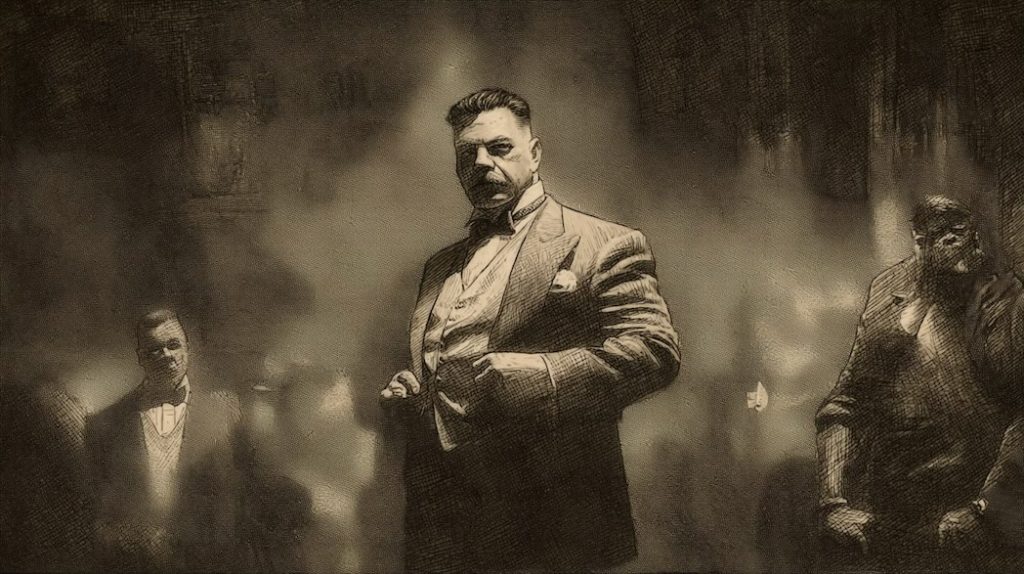
“Sorry,” Don stammered, shrinking three sizes. “Carlo.”
“Mmm.” Carlo made a noncommittal sound deep in his throat. He smoothed the lapel of his jacket. “So. See you at the card game Saturday night?”
“M-hm,” Don nodded vigorously, his head threatening to detach. “Absolutely.”
“It’s a five-thousand-dollar buy-in.”
Don froze. Five thousand dollars in 1926 was not merely money; it was a theoretical amount of wealth, enough to purchase a small country or a very large conscience.
“Five K?” Don squeaked. “That’s a little steep for…”
“But if you can’t swing it…” Carlo let the sentence hang there, a dangling precipice.
“Oh, I can swing it,” Don said quickly, his pride writing checks his bank account would likely vomit up. “Five K it is.”
Don exited the theater with considerably less volume than he had entered.
Quinn turned to Skids. “Meet me at the diner. I’ll get your money.”
Skids took the hint. Being fifteen years old in the presence of Carlo Rizzo was a survival risk similar to juggling chainsaws while blindfolded. He evaporated out the door.
“Mornin’, boss,” Quinn said.
Carlo checked a pocket watch that looked expensive enough to tell the time in other dimensions. “It’s noon.”
“Yes, sir.”
If Carlo Rizzo said it was noon, the sun generally hurried to catch up.
They moved toward the ornate stairwell. The thug held the door open, and Carlo stepped through.
“Carlo Rizzo owned the place,” Elizabeth’s voice noted, dry as the gin currently being manufactured in bathtubs across the city. “People called him “The Bull,” though never to his face unless they had a death wish or a very poor grasp of etiquette. Lots of people said he was a “mobster,” but you have to understand the times. This was Prohibition. Everybody and their brother was brewing alcohol. Legality was a blurry line drawn in vanishing ink. So, I guess in a way, they were all mobsters.”
The office was a testament to ambitious interior design: red carpet deep enough to lose a shoe in, stained walnut wainscoting that smelled of lemon oil and cigar smoke, and damask wallpaper that was beginning to fade, suggesting that even luxury has an expiration date.”
Chapter 3
The War is Declared Over, and Coffee is Declared Suspect
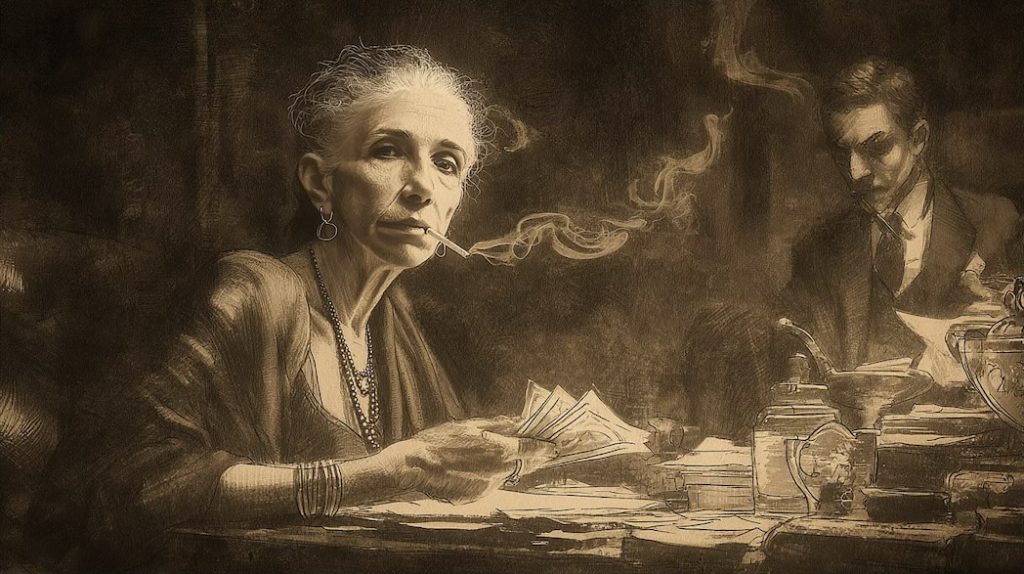
To the left of the entrance sat Opal Lassiter. She was installed behind a desk that was less a piece of furniture and more a defensive fortification constructed of ledgers, piles of cash, and a cloud of tobacco smoke so dense it likely had its own weather patterns.
Opal was counting money. A lit cigarette defied gravity, hanging precariously from the corner of her mouth, its ash growing to a length that made physicists nervous.
Carlo moved past her, heading for the sanctuary of his office like a ship seeking a harbor that didn’t charge docking fees.
“How’d we do last night, Opal?”
“Meh,” Opal grunted, not looking up. “Broke even, probably. With a little extra.”
“How little was the extra?”
“Whaddya want, get rich?”
“It would be nice,” Carlo admitted.
“Well, you better hurry up then,” Opal said, slapping a stack of bills onto the desk with a sound like a pistol shot. “You’re forty.”
“Very funny,” Carlo said. “Any calls?”
“Just Charlie Drasko.”
Carlo groaned. It was the sound of a man who had just realized his shoes were too tight. “Oh God. What’d he want?”
“He’s got another singer. Wants you to book her.”
“I got a singer.”
“That’s what I told him.”
“You’re a peach, Opal.”
“Uh-huh.”
Carlo paused in his doorway. “If anybody calls, I ain’t here.”
“Uh-huh.”
He closed the door. Opal was left alone with the money, the smoke, and the silence. She lit a fresh cigarette off the dying ember of the old one, a seamless transfer of addiction.
“When I was walking down the stair,” she muttered to the cash, “I met a man who wasn’t there.”
The door opened. It was Quinn Sterling.
“Morning, Opal.”
“It sure is,” she replied, in a tone that suggested she had seen better mornings and wasn’t particularly impressed with this one.
Quinn crossed to a coffee pot that sat on a wood heater. The liquid inside was black, viscous, and had likely been boiling since the Coolidge inauguration. He poured a cup.
“This stuff fresh?”
“Maybe,” Opal shrugged. “You know who probably has fresh coffee? The diner next door. Got milk and sugar and everything.”
“Charming as always,” Quinn said, taking a sip and regretting it immediately.
“Miss Warm Springs, that’s me.”
“I need petty cash,” Quinn said, trying to scrape the taste of burnt rubber off his tongue.
Opal sighed and pulled a small metal box from her desk. “How petty?”
“Three dollars and seventy-six cents. The boss hasn’t paid the paperboy in over four months.”
Opal paused. “We take a paper?”
“Yeah,” Quinn said. “War’s over. Germany surrendered.”
Opal counted out the coins. “There you go. Get a receipt.”
“You got it.”
Quinn grabbed his cup of hot sludge and headed out, presumably to find a drain or a very hardy plant.
Opal went back to the money. The bills rustled under her fingers, the only applause she needed.
“He wasn’t there again today,” she whispered, “I wish that man would go away.”

Don’t Leave the Table Just Yet. Read the Full Story of Tamarind:Vaudeville!
TAM’S PILOT — COMING SOON
Cairn is currently adjusting the headset. Jimmy is on the back deck with a bag of fries. Blanche is eyeing the doughnuts.
Tam’s Pilot is currently undergoing final staging and visual assembly before taking the main stage at Imaginal Press.
Enter your contact info below to join the VIP list and be notified the second the doors open!
FREE MONTHLY COMIC: “ABE: TIME TRAVELER” – Coming Soon
1580 BCE. A 17-year-old Canaanite boy. A quiet meal with family and Minoan guests. Then Thera erupts—and the timeline splits wide open.
Follow Abe and his unexpected crew as they are catapulted across centuries in an ongoing, free 10-page monthly comic script series!
Enter your contact info below to join the VIP list and be notified the second Epic begins.
« Previous: Tam’s Pilot (Coming Soon)∣Next: Brunch with Adam and Eve »