Prologue
Something He Found (2024)
The Tam Dinner Theatre was a building that had spent the first seventy years of its life trying to be a palace of sin, and the next seventy years trying to apologize for it.
It stood as a remarkably clean architectural debate. It wasn’t the sort of over-elaborate, gilded wedding cake you’d find in the more boastful corners of the Ozarks; it was something far more deliberate. The original 1883 Victorian bones—all sharp gables and sturdy woodwork—had been spared the indignity of decay, held together by the Great Remodel of 1955. That mid-century intervention had gifted the façade with a massive, sweeping veranda that wrapped around the building with the confident, clean lines of a well-tailored suit. Under Cairn’s watchful eye, the wood didn’t groan, and the paint didn’t peel; instead, the theater sat in the humid afternoon air with the quiet, polished poise of a grand dame who had recently come into a very comfortable inheritance.
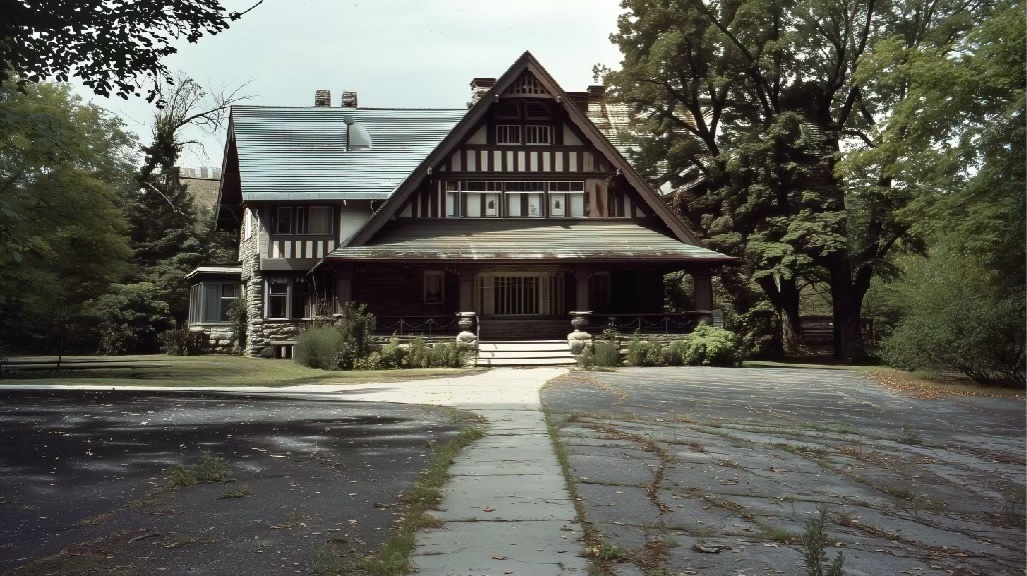
The veranda was long. Improbably long. It was built during a brief, optimistic period when the owners believed Little Neck Falls was about to become the next Riviera. It featured terrazzo floors that were now cracked in the shape of interesting continents, and a roofline that extended far enough to shelter a marching band, though currently, it only sheltered a very nervous man in a tweed jacket.
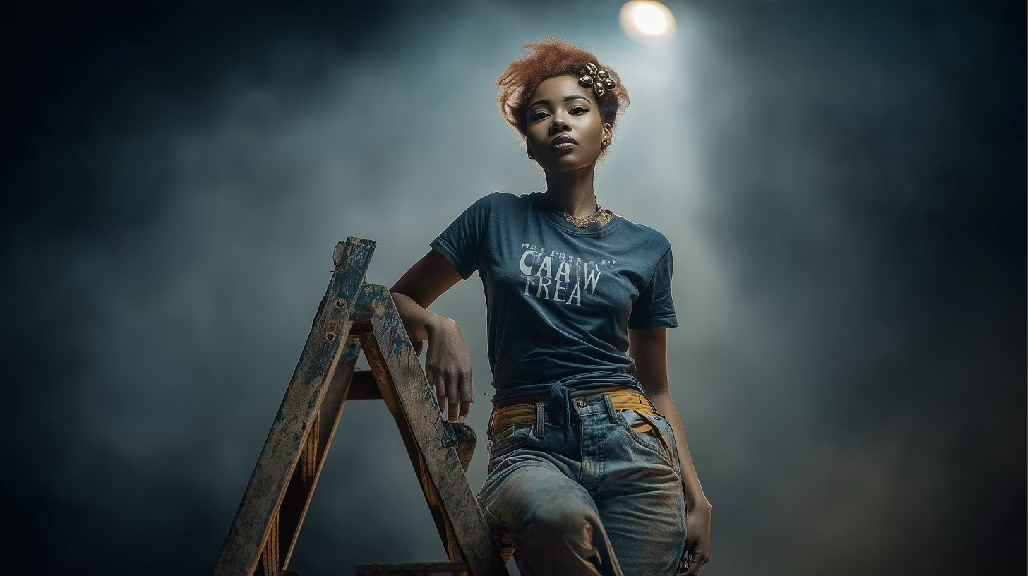
Inside, Cairn Albert was shouting at a lightbulb.
Cairn was the stage manager, a job that required the diplomacy of a hostage negotiator and the mechanical skills of a bomb disposal expert. She was twenty-three, with the sort of striking coffee-and-cream complexion that suggested her Jamaican and Irish ancestors had decided to collaborate on a masterpiece. Her red hair was pulled back in a severe bun, and her blue eyes were currently glaring at a spotlight that was flickering in Morse code.
“It’s doing it again,” Cairn said. “It’s trying to communicate. I think it’s asking for a sacrifice.”
“It’s just a loose filament,” said Zoe from the floor. Zoe was Cairn’s best friend, a compact Greek woman with dark, frantic hair and the energy of a squirrel who had just discovered caffeine. She was currently wrestling with a microphone stand that had seemingly lost the will to stand.”It’s not a filament, Zoe. It’s the building. The Tam is moody today. I felt it when I walked in. The floorboards in the hallway were sighing.”
“That was the HVAC,” Zoe grunted, finally getting the stand upright. “Or the ghost of the 1955 contractor.”
The front door, a heavy oak slab located at the center of the Long Veranda, groaned open. It was a sound like a cello being dragged across gravel.
A man stepped inside. He paused, blinking as his eyes adjusted to the curated, amber-hued dimness of the house. He was clutching a leather satchel to his chest as if it contained a live bomb, or perhaps a particularly temperamental sourdough starter. He glanced toward the stage, where the heavy, deep-red velvet curtains hung in stiff, pristine folds—each pleat sharp enough to cut a conversation short. To his left, the great Victorian stained-glass window glowed with backlit precision, its intricate lead-work polished to a silver sheen and notably free of the plywood that had supposedly obscured it since the seventies. The theater didn’t smell of rot; it smelled of lemon oil, old stage wax, and the quiet, looming authority of a manager who didn’t tolerate dust.”We’re closed!” Zoe shouted helpfully. “Come back at six! Tonight is The Mystery of the Murdered Duke. Spoiler alert: It was the butler. It’s always the butler because we only have three actors.”
The man did not leave. He walked down the center aisle, his shoes clicking nervously on the floor.
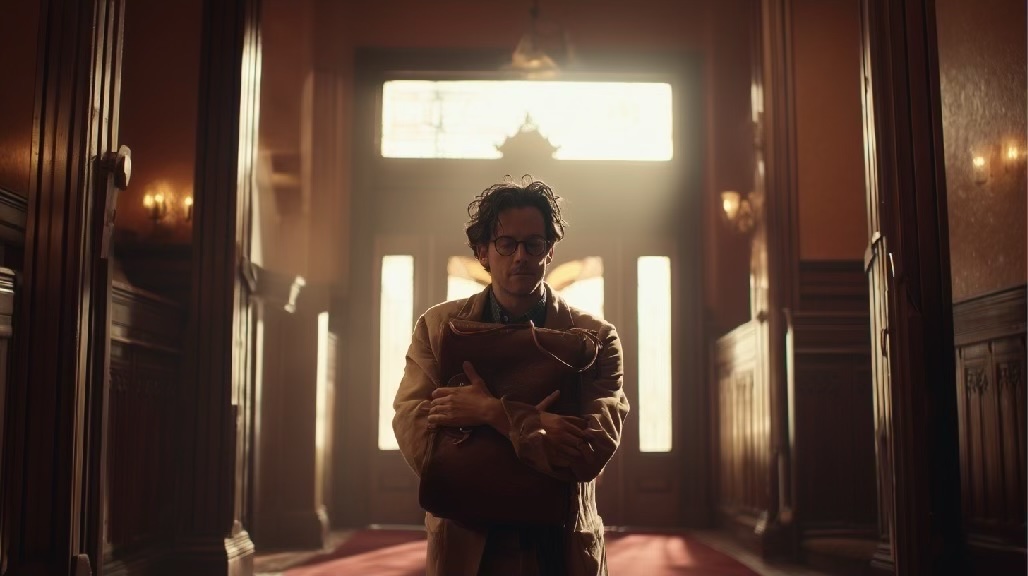
“I am looking for… The Tamarind,” he said. His voice was dry, like old paper.
Cairn climbed down from the ladder. She wiped her hands on her jeans. “You found The Tam. We call it the Tam because people confuse a sweet fruit with a horny little monkey.
The man’s coffee cup stopped hovering exactly three inches from his mouth as his brain desperately tried, and failed, to un-see the mental image that sentence had just violently forced upon him.
“And the ‘D’?” he asked, looking around.
“Nobody talks about the ‘D’,” Cairn said. “Local superstition. Bad luck to mention it.”
The man reached the stage. He set his satchel down on a prop table. He looked at Cairn, then at Zoe, and finally at the sweeping curve of the back wall.
“My name is Arthur Penhaligon,” he said. “I am an archivist from the Denver Public Library. Special Collections.”
Cairn crossed her arms. “If this is about the overdue copy of Showboat, we don’t have it.”
“It is not about a book,” Arthur said. He unbuckled the satchel with trembling fingers. “I work in the ‘Unclaimed Fortunes and Frontier Eccentrics’ division. We recently processed the estate of a cattle baroness named Star Eden. She died in 1943.”
He pulled out a bundle of papers wrapped in oilcloth. They smelled of cedar and time.
“She wrote these,” Arthur said, his voice dropping to a whisper. “Letters. Addressed to a Mr. Roy Vance. They were never sent.”
Cairn looked at the bundle. The top letter was addressed in a frantic, looping script to: Roy Vance, somewhere in the Jungle. Look for the Monkeys.
“Why bring them here?” Zoe asked, stepping closer.
“Because,” Arthur said, tapping the stack. “According to her will, and a very confusing addendum involving a banjo player, these letters belong to the building. She didn’t trust the mail. She said the building would know what to do with them.”
Cairn picked up the first letter. It felt heavy.
“And,” Arthur added, looking nervously at the flickering spotlight, “there is a deed. It seems the ownership history of this establishment is… more complicated than the county records suggest.”
Cairn looked at the letter, then out toward the lobby, past the heavy doors to the Long Veranda, where the afternoon sun was baking the terrazzo.
“Complicated,” Cairn said, a small smile touching her lips. “I knew it. The Tam isn’t haunted, Arthur. It’s just… undocumented.”
She looked at Zoe. “Go turn on the coffee pot. I think we’re going to be here a while.”
Chapter 1
The Unpleasantness of Roach Class
The SS Periplaneta was a vessel belonging to the illustrious John Roach & Sons line. This company had built its reputation on the solid American principle that if you welded enough iron plates together, physics would eventually just give up and let the thing float.
It was currently engaged in the act of steaming from New York to Rio de Janeiro, a journey that usually took three weeks but felt, to those in steerage, like a geologic era.
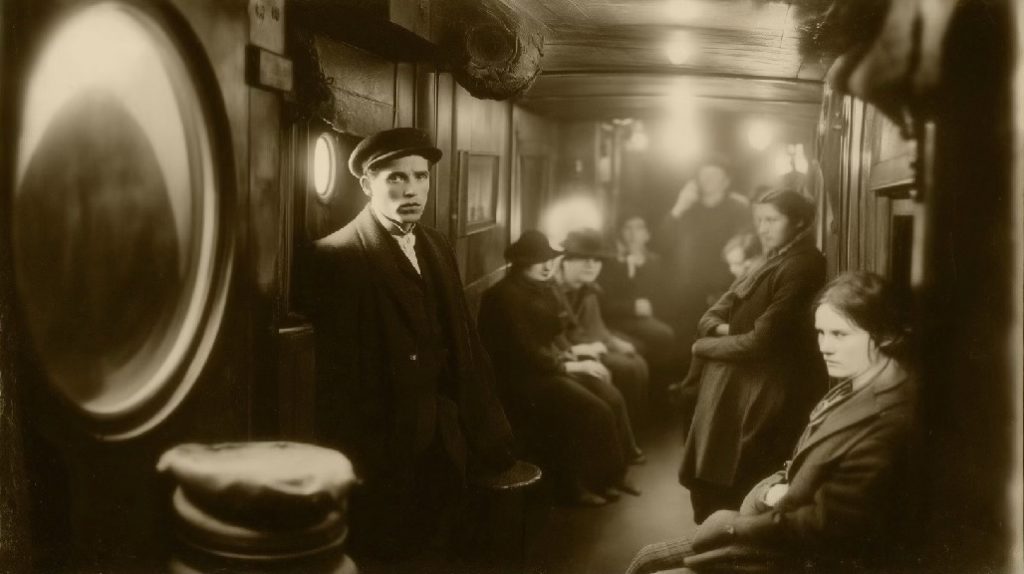
Steerage class on the Periplaneta was not so much a mode of travel as it was a social experiment in how many humans could be compressed into a dark, vibrating steel box before they spontaneously reinvented cannibalism. The air tasted of coal dust, unwashed wool, and a soup that the ship’s cook claimed was “beef reduction” but which the passengers suspected was actually just hot water that had been shouted at by a cow.
In the midst of this sensory assault sat Star Eve, a young woman who possessed the rare ability to remain entirely still while chaos orbited her like a confused moon. Next to her sat Roy Vance.
Roy was a man of vision. Unfortunately, his vision was usually focused on things that were not there, while entirely missing the things that were—such as low beams, open manholes, and the fact that his “Gold Rush Survival Suit” (a tuxedo he had modified by sewing twenty-seven pockets into the lining) was causing him to sweat fast enough to alter the room’s humidity.
“It’s the silence that gets you,” Roy whispered, staring intensely at a rivet in the wall.
“It is literally deafening in here, Roy,” Star said. She was currently reading a three-month-old newspaper for the forty-second time. “The engine sounds like a cathedral falling down a flight of stairs.”
“The social silence, Star. The calm before the storm. I don’t like it. The air feels… thick.”
“That would be the soup.”
At that moment, the ship’s engines gave a particularly violent shudder, known technically in maritime engineering as a “hiccup,” and slowed. Through the grime-encrusted porthole—which was roughly the size of a tea saucer and twice as dirty—a small, wooden fishing boat could be seen bobbing in the Atlantic swell.
The fisherman, a local of the coast they were skirting, stood up in his boat. He waved a large, limp fish at the massive iron steamer and shouted something in Portuguese.
To a fluent speaker, the fisherman had shouted: “Do you want to buy a Grouper? It is very fresh!”
To the linguistic ecosystem of steerage class, however, this sentence underwent a rapid and terrifying evolution.
The man nearest the porthole, a bricklayer from Jersey who spoke no Portuguese but considered himself a good guesser, turned to his neighbor. “He says they got the fever ashore. Bad. Turning people yellow.”
His neighbor, a nervous accountant fleeing an audit, turned to Roy. “Yellow Fever! The port is closed! They’re turning the ships away to rot at sea!”
Roy Vance stood up. The pockets of his survival tuxedo clanked with the sound of a thousand useless items—compasses, protractors, and a collapsible shovel he had bought from a man who promised it could also be used as a salad tong.
“I knew it!” Roy announced, his voice cracking with the thrill of impending doom. “The pestilence! We’re sailing directly into a plague zone, Star! It’s a trap!”
“Roy,” Star said, not looking up from an advertisement for Patent Liver Pills. “It was a fish. The man was holding a fish.”
“That’s how it starts!” Roy cried, grabbing his primary piece of luggage—a sheer-canvas bag containing a tuba. He had insisted on bringing the tuba because he believed music was the universal language, and he wanted to be ready to negotiate with the natives. “The fish are dying! The water is toxic! We have to abandon ship before the quarantine flags go up!”
“We are in the middle of the ocean.”
“Details!” Roy grabbed Star’s wrist with a grip that was surprisingly strong for a man whose diet consisted entirely of nervous energy and biscuits. “I have studied the maritime charts. Or at least, I looked at a tablecloth that resembled a map. We are close to the coast. If we stay, we die of the fever. If we leave, we seize our destiny!”
Star looked at Roy. She looked at the crowded, sweating mass of humanity around her. She looked at the bowl of “beef reduction” vibrating on the table.
“Fine,” she said.
The process of heisting a lifeboat from a Victorian steamer is generally considered difficult, mostly because the British Board of Trade requires lifeboats to be secured with ropes, chains, canvas covers, and a layer of bureaucratic indifference.
However, Roy Vance possessed a frantic, terrified strength that defied physics. He dragged Star and the tuba up three flights of stairs, past the bewildered crew (who assumed that anyone moving with that much purpose must have authorization), and onto the boat deck.
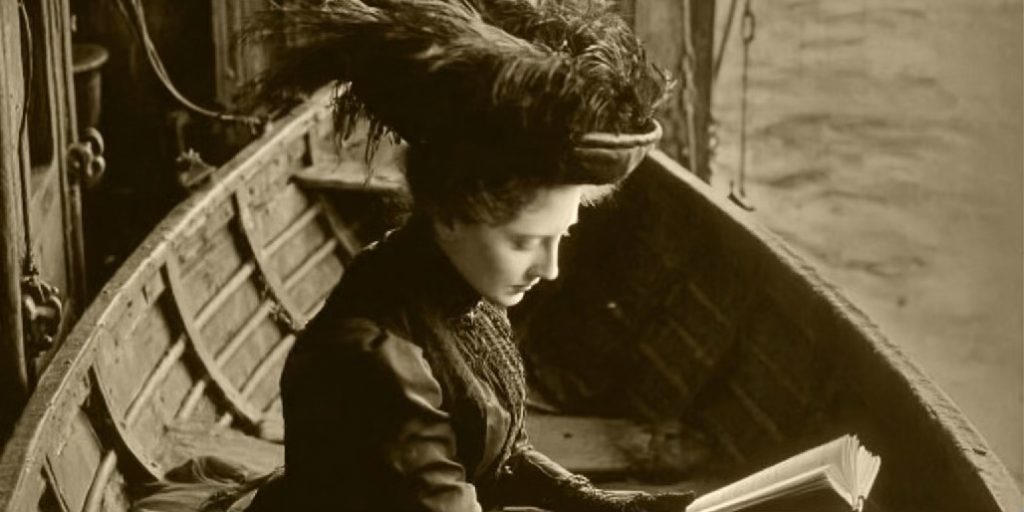
“That one,” Roy pointed to Lifeboat No. 7. It was small, clinker-built, and looked like it had been painted by someone angry at the concept of wood.
“Roy, do you know how to operate the davits?” Star asked, looking at the complex tangle of pulleys and rusty gears.
“It’s just gravity, Star! The most reliable force in the universe!”
Roy began unspooling ropes with the frantic motion of a cat trying to escape a yarn factory. A small crowd of first-class passengers had gathered nearby. They were drinking sherry and watching with mild interest, assuming this was some sort of afternoon entertainment provided by the cruise line, possibly entitled The Peasants’ Revolt against Safety.
“You there!” Roy shouted at a well-dressed banker. “Don’t just stand there! The fever is coming! The fish are yellow! Help me with this winch!”
The banker politely declined, but threw a coin at Roy’s feet.
“Get in!” Roy screamed.
Star climbed into the lifeboat. She arranged her skirts, placed her small valise on the bench, and sat with her hands folded in her lap. “I would like it noted,” she said to the open air, “that I voted against this.”
Roy pulled a lever.
Ideally, a lifeboat descends smoothly and horizontally. Lifeboat No. 7, however, decided to interpret Roy’s command as a request for immediate verticality. The bow dropped ten feet in a single second, while the stern remained perfectly still.
Star slid forward, colliding gently with the tuba.
“Working on it!” Roy yelled, kicking a rusted gear. The stern dropped with a screech that sounded like a banshee stubbing its toe. The boat swung wildly, slamming into the side of the SS Periplaneta with a hollow thud that knocked a rust flake into Roy’s eye.
“Precision descent!” Roy announced, wiping his eye. “Almost there!”
With one final, grinding protest, the ropes played out, and the lifeboat hit the water with a splash that was less of a majestic entry and more of a clumsy belly-flop.
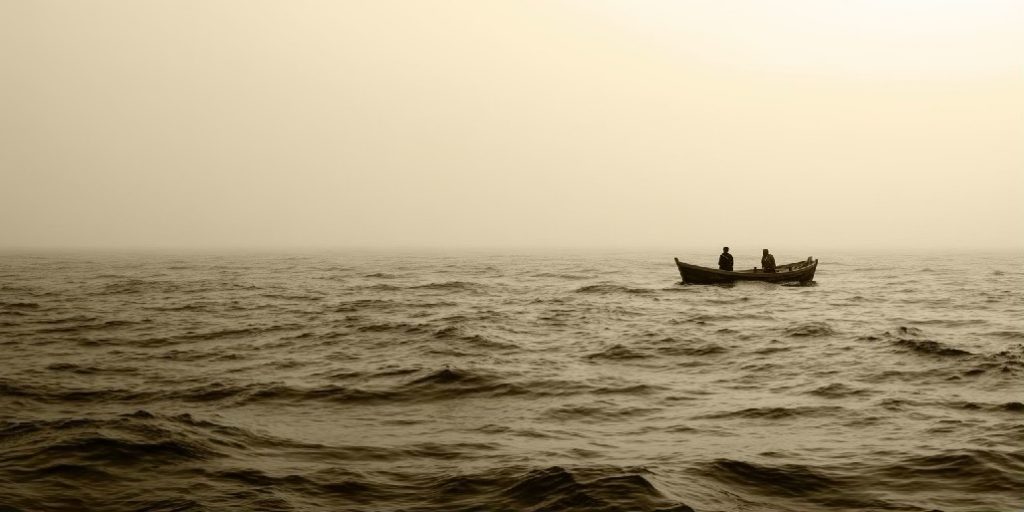
Roy frantically unhooked the falls, nearly decapitating himself with a swinging pulley block. He grabbed the oars. “Row, Star! Row for your life! Before the microbes catch us!”
Star did not row. She simply watched as the massive iron hull of the Periplaneta rumbled past them. High above, along the railing, the first-class passengers clapped politely. One of them threw a sandwich.
As the steamer churned away toward the horizon, leaving them bobbing in the vast, silent Atlantic, Roy stopped rowing. He adjusted his tuxedo, which was now damp and smelled of low tide.
“Well,” Roy said, looking at the empty horizon where he assumed Brazil was. “That was a close one. I think we made the right call.”
Star picked up the sandwich.
Chapter 2: The Long Drift
Mid-Morning: The Departure
The SS Periplaneta was now just a smudge of coal smoke on the horizon, a stain on an otherwise perfectly adequate sky. “Tactical,” Roy said, adjusting his wet tuxedo lapels. “That is the word. We have executed a tactical withdrawal from a biohazard zone.”
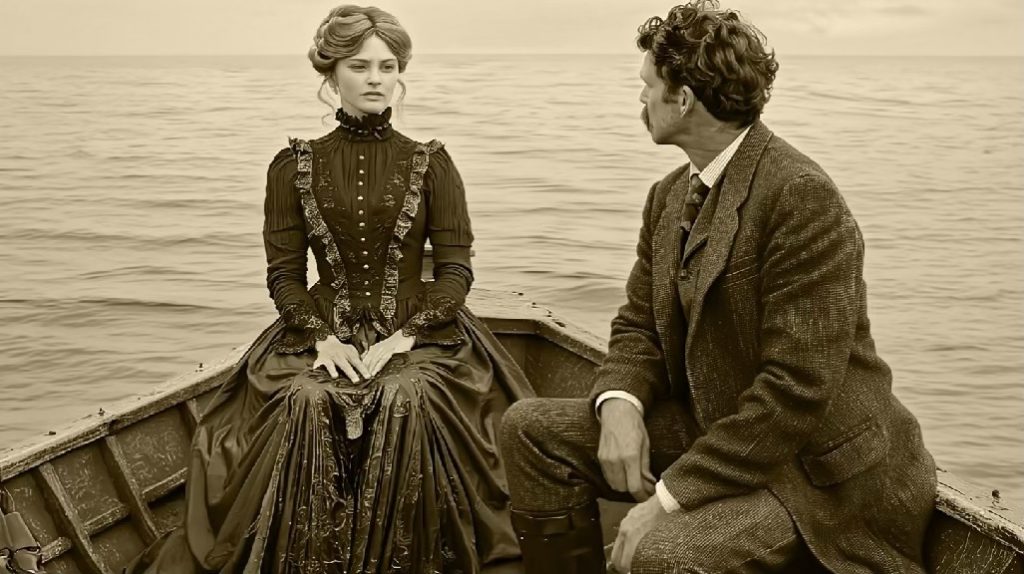
“We have jumped into a rowboat in the middle of the ocean,” Star corrected, wringing out the hem of her dress.
“And look at the ventilation!” Roy gestured expansively at the empty Atlantic. “Fresh air! No microbes! Just pure, unadulterated oxygen and… salt.” He licked his lips. “A surprising amount of salt, actually.”
Star opened her small valise. Inside, neatly folded, was a single change of clothes, a map of South America (which Roy had already dismissed as ‘pessimistic’), and the ham sandwich the first-class passenger had thrown.
“I am going to eat this sandwich, Roy,” she said. “And I am not going to share it. Because you brought a tuba.”
“The tuba is a strategic asset!” Roy cried, grabbing the brass instrument, which was currently floating in three inches of bilge water. “It commands respect! It announces our arrival!”
“It is currently announcing that we are idiots,” Star said, and took a bite of ham.
High Noon: The Inventory
The sun hung directly overhead, a blazing white eye that seemed personally offended by Roy’s survival suit.
“We must take stock,” Roy announced, sweating profusely. He began pulling items from his twenty-seven pockets.
“Item one,” he said, holding up a small glass jar. “Moustache wax. Essential for morale. A gentleman does not conquer the jungle with drooping whiskers.”
“Item two,” Star noted, pointing at a leather-bound book on his knee. ” Portuguese for Gentlepeople.”
“Language is power, Star. Listen to this.” Roy opened the book to a random page. ” ‘O meu mordomo poliu a prataria incorretamente.’ That means, ‘My butler has polished the silverware incorrectly.’ Invaluable. Shows we have standards.”
“Roy,” Star said, staring at the relentless, flat blue horizon. “Do you have any water?”
“I have something better,” Roy said, pulling out a brass compass. He shook it. The needle spun wildly, then settled on pointing directly at his own chest. “It’s attracted to the gold in my heart, Star. Or possibly the zipper on my vest. Either way, it indicates we go… that way.” He pointed vaguely to the left.
“That is West,” Star said. “Brazil is West.”
“Exactly! The compass knows!”
“The sun is setting that way, Roy. You are pointing at the sun.”
Late Afternoon: The Menu
The thirst had set in. Roy was now hallucinating slightly.
“When we land,” Roy whispered, staring at a cloud that looked suspiciously like a roast chicken. “I shall order the Feijoada.”
“We are drifting,” Star said, closing her eyes.
“It is a delicacy, Star. La Feijoada. I read about it. It is a golden lark, crusted in diamonds and served on a bed of… currency. Yes. The waiter will bring it to me on a velvet pillow, and I shall say, ‘Keep the diamonds, garçon! I am here for the meat!
“You are licking your sleeve, Roy.”
“It tastes like victory,” he mumbled. “And wool.”
Moonrise: The Dominion of Brass
“The tuba is a strategic asset!” Roy cried, grabbing the brass instrument, which was currently floating in three inches of bilge water. “It commands respect! It announces our arrival!”
“Listen to them,” Roy said, sitting up. “Mocking us. Asserting their territory. They think they own the silence.”
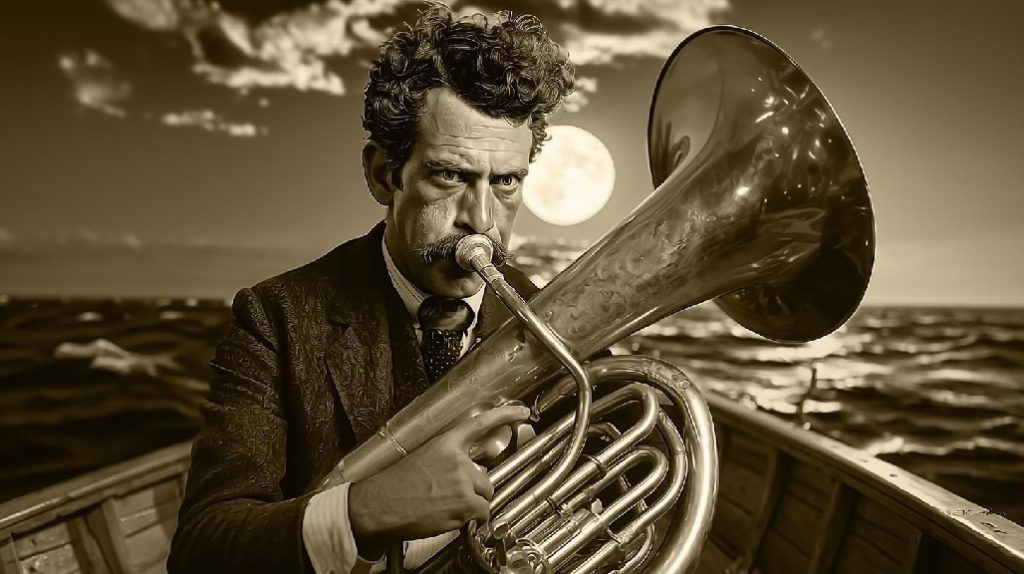
He reached down and picked up the tuba. He emptied the seawater from the bell with a gurgling splash.
“Roy,” Star warned. “Don’t.”
“We must establish dominance, Star. We must show the jungle that Civilisation has arrived, and it is in the key of B-flat.”
Roy Vance took a deep breath, puffed out his cheeks, and blew.
The note that emerged was not so much a musical tone as it was a profound, brassy fart that echoed across the water, bouncing off the waves and rolling toward the dark, unseen coastline.
BWAAAAAAAAMP.
The monkeys went silent.
“See?” Roy whispered, satisfied. “They are terrified.”
From the darkness, a single, much louder scream answered back.
SCREEEEEE!
“They’re negotiating,” Roy nodded. “Get ready, Star. We’re going in.”

Don’t Leave the Table Just Yet. Read the Full Story of Brunch with Adam and Eve!

TAM’S PILOT — COMING SOON
Cairn is currently adjusting the headset. Jimmy is on the back deck with a bag of fries. Blanche is eyeing the doughnuts.
Tam’s Pilot is currently undergoing final staging and visual assembly before taking the main stage at Imaginal Press.
Enter your contact info below to join the VIP list and be notified the second the doors open!
FREE MONTHLY COMIC: “ABE: TIME TRAVELER” – Coming Soon
1580 BCE. A 17-year-old Canaanite boy. A quiet meal with family and Minoan guests. Then Thera erupts—and the timeline splits wide open.
Follow Abe and his unexpected crew as they are catapulted across centuries in an ongoing, free 10-page monthly comic script series!
Enter your contact info below to join the VIP list and be notified the second Epic begins.